
Hamstring injuries are common amongst both social and elite athletes, across a range of activities like AFL, soccer, tennis, dancing, skating, skiing, athletics and various types of running[1]. Hamstring injuries occur most frequently in sports that require rapid acceleration, power and changes in direction. These factors combine to challenge the hamstring muscles to contract quickly, at the right time and with the right amount of force – if any of these factors are not optimal, a hamstring injury can occur. To minimise the likelihood of a hamstring injury happening – we need to know what the hamstrings are and how they function.
What Are The Hamstring Muscles And What Do They Do?
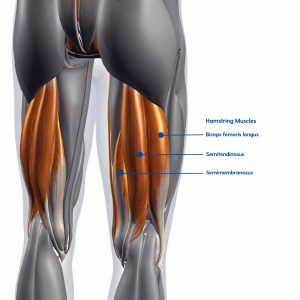 The hamstrings are a group of three muscles at the back of the upper leg between the hip and the knee. The muscles are the:
- Biceps femoris
- Semimembranosus
- Semitendinosus
These muscles connect to the bottom of the pelvis and the top of the shin bones just below the knee. Their role is to bend the knee and straighten the hip. The hamstrings work in opposition to the quadriceps muscles which are at the front of the thigh and straighten the leg. The quadriceps are the largest muscles in the body and are stronger than the hamstring muscles.
How Do Hamstring Injuries Occur And Who Is At Risk?
A hamstring injury is a strain or a tear in one or more of the muscles or tendons of the hamstrings. Just like other soft tissue injuries, hamstring injuries are graded from a pull or strain (least severe) to a partial tear, and finally to a complete rupture (most severe).
The way the injury occurs largely depends on the type of activity or sport. In sports that require kicking, injury can occur when the kick overstretches the muscles past the point they can normally and safely handle. In other high-intensity sports, rapid acceleration, sometimes when the muscle is already fatigued, can be responsible for causing the muscle to strain or tear.
In social athletes, excessive imbalance between the strength of the hamstrings and quadriceps can lead to injury. For experienced athletes, the injury may be associated with pushing too hard or going for too long.
There are some well-documented risk factors for hamstring injury[2]:
- Previous hamstring injury
- Increasing age
- Sudden acceleration and deceleration
- Poor flexibility
- Biomechanical factors
How Do You Know If You Have Suffered A Hamstring Injury?
The symptoms of a hamstring injury depend on the severity of the damage.
For a mild strain you may experience:
- Pain that begins after you complete the activity
- Pain when sitting or walking up hills or stairs
- Weakness in the injured leg and inability to weight bear on the affected leg
- Muscle tightness
For a partial tear you may experience:
- Immediate pain
- Tenderness
- Weakness in the injured leg and inability to weight bear on the affected leg
- Pain when you bend the leg
For a more significant partial, or complete tear, you may experience:
- A popping sensation at the time of injury
- Sudden stabbing pain in the area of the muscles
- Tenderness
- Inflammation immediately after the injury
- Bruising
- Weakness in the injured leg and inability to weight bear on the affected leg
Treating Hamstring Injuries
The treatment for a hamstring injury depends on the severity but begins by doing things that reduce pain and discomfort. This includes applying ice appropriately, avoiding activities that cause pain, rest, using compression on the upper leg and keeping the leg elevated in the initial stages.
For patients with mild to moderate symptoms, conservative treatment is recommended, supporting the injured structures to heal and reduce the risk of re-injury. This may include[3]:
- Biomechanical assessment and correction
- Managing neurodynamics (particularly the sciatic nerve)
- Increasing trunk muscle control
- Strengthening weakened muscles as a result of the injury or that may have contributed to the injury
- Incrementally increasing running speedwork
- Stretching tight muscles that may have contributed to the injury
- Gait retraining to work on proper technique and reduce the risk of future injury
For a very small number of patients with severe symptoms and where a complete tear has been identified, surgery may be required to repair the damaged muscles or tendons. We can refer you for a specialist surgical consultation if this is the case.
How Long Does It Take To Recover From A Hamstring Injury?
Many people with hamstring injuries do well with the right treatment. For some, however, hamstring injuries can be frustratingly slow. It is important to get the right advice and management early and to ensure you are addressing any potential contributing factors. Remember previous hamstring injury is a risk factor for future hamstring injuries, so it’s important to get your rehab right the first time.
The return to activity may be anywhere from two weeks to over three months and will be based on [4]:
- Absence of pain
- Ability to perform all required movements
- Recovered strength
- Recovered flexibility